Monday, December 9, 2019

Virtual Reality in Russia


Experts (in cow anxiety) noted a reduced anxiety and improved emotional mood in the herd that was adorned in VR goggles.

(A cow in Russia, fitted with a virtual reality headset)

     I have always had an interest in virtual reality, upon doing some research on what Russia has been working on in that field I found a very peculiar article. Russian farmers have begun to fit their cattle with virtual reality headsets (no, this is not a joke). My first impression when reading through this article was that cows were starting to experiment playing virtual reality video games, similar to what people can play on a device such as an Oculus Quest, unfortunately that's not the case, however, this is still neat. The purpose of these cows wearing virtual reality headsets is that the farmers hope to see an increase in milk production. The reasoning behind this experiment is that the cows equipped with these devices would have lower anxiety, based on research from other countries, cows with lower anxiety levels tend to produce more milk. What the cows get to see are beautiful green open pastures, depicted in the summer season. These headsets aren't just your standard VR headsets that can be found on sites such as Amazon though, they were intricately designed to fit to the shape of a cow's head. Findings from this experiment noted that the cows were in an improved emotional state and that these virtual landscapes, did in fact lower their anxiety.

Posthuman Studies's Russian Ferations (2019) is

(One of the first works commissioned by Garage Digital, Russian Federations)

A woman by the name of  Dasha Zhukova, a resident of Russia and the founder of the Garage Museum of Contemporary Art, has begun a new, ambitious project titled "Garage Digital" Garage digital is a new initiative that will allow artists to commission their own digital artworks while also providing historical contexts for their older works. Garage Digital is an entirely virtual art gallery, which can be found within the walls of the physical museum. The purpose of this project is to support code within the interior of the building's walls, allowing visitors to view the original works alongside the digital perspectives of them, with detailed descriptions about the creator and the meaning behind them. The museum also plans to implement art, video game design, and computer simulations to fully immerse visitors into what could be deemed as an entirely virtual and interactive art gallery.

Wanna learn more about this incredibly awesome project and see some videos detailing the experiment, check out the link below:
https://observer.com/2019/12/vr-headsets-russian-cows-milk-production/

More information about the Garage Digital Art Gallery can be found below:
https://www.artnews.com/art-news/news/garage-museum-digital-platform-1202670950/

Technology in the Russian Classroom


Image result for irbis tablet
(One of the more recent models of Russia's Irbis tablets)

     Education paves the way for developing minds in a country, the effectiveness of an education system has a direct impact on the future of a country. Technology is being integrated into the classroom more and more everyday and Russia is making the most out of it. Russia began a project called the Moscow Online School Project just a few years ago and it has already become the largest project in the world for digitization in the classroom. Nearly one million students are a part of this program and sixty-five thousand teachers are sharing their expertise with these students. The project features some of the highest Internet speeds in the country and has converted classrooms into high-tech media centers with modern devices and a single point of data storage. Promethean, a Russian tech company, created a tablet like interfaces called Irbis that features a customizable interface that teachers and students can use to personalize their experience to match their goals, nearly twenty-two thousand classrooms are utilizing these devices.


(Indian PM Narhendra Modi with Russian President Putin and other world leaders, at the 2016 BRICS conference)


The educational technology sector in India is one of the country's largest sectors, Google estimates that this sector alone could be worth nearly two-billion dollars. What does this mean for Russian education, well, it means that the nation's capital, Moscow, sees this as an opportunity for collaboration with New Delhi in educational technology. Moscow State University, along with other India institutions, have discussed partnerships This isn't the first time the two nations have discussed cooperation in higher education, back in 2016 Prime Minister Modi and President Putin conversed about the topic with the former stating that "Russia is India's unwavering friend".


Want to read more in full about the digital classroom, the Irbis system, and even chess? Check out this article:
https://edtechnology.co.uk/Blog/chess-meets-tech-in-russian-schools/

India and Russia have big plans in store for their students in the future, if you wish to read up about the topic a little more in depth, click on the link below:
https://thepienews.com/news/russia-eyes-edtech-development-with-india/

Sunday, December 8, 2019

A Look Into Russia's Military Technologies

(One of Russia's current tank models)

     Over the course of the past few years, Russia has been making breakthroughs in developments of innovative technologies. Being one of the world's leading producers of modern technology, it shouldn't come as a surprise to anyone that the country has been integrating their latest developments into their military. Specifically, Russia has been focusing most of their research into complex robotics and artificial intelligence. Right now, Russia owns the second largest Unnamed Aerial Vehicle (UAV) fleet out of every country, behind the United States and above Canada, with nearly four-thousand of these in their arsenal. "Russia’s sophistication in military AI is characterized by fast, efficient machines that can handle data, break down the complex information within split seconds, and relay it to the soldiers handling it" (Giridharadas, 2019).

Russia to Arm Ground Forces With New Ballistic Missile by 2020
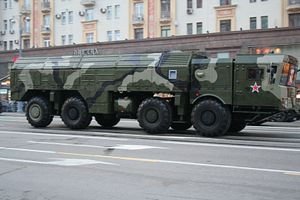
(A look at one of Russia's, on-ground ballistic missiles)

Russia has been developing and perfecting their SS-26 Stone's, which is a fancy name for their short-range road unit nuclear ballistic missile systems. Currently, these are still being worked on, however, by the end of 2020, the country says that all of the missile units of the Russian Ground Forces will be fitted and equipped with these attachments. "The tactical ballistic missile can be deployed to destroy a host of different targets including missile and multiple launch rocket systems, artillery batteries, as well as command posts and communications centers" (Gady, 2017). Russia plans on sharing these missiles with countries such as China, India, and South Korea, however, the variants that would be shipped out to these countries cannot be armed with a nuclear warhead, whereas the country's local variant can be. 

While it's impressive how rapidly Russia is pushing out and perfecting this kind of technology, it makes you wonder how this will affect the world in the long run, and what these breakthroughs mean for other countries. If you wish to read up more about some of the technologies discussed in this post, consider checking out these two sites to learn more about them:

Robotics and AI:
https://nationalinterest.org/blog/buzz/russias-military-transforming-and-getting-stronger-right-our-eyes-67907

Ballistic Missiles:


Thursday, October 10, 2019

A Look Into Russian A.I.

Image result for russian ai
(Sophia, one of Russia's more recent and prominent examples of their advancements in AI and robotics)

Due to governmental corruption and pervasive state security, Russia can be a very difficult place for innovation to thrive. A prime example of this occurred back in 2010 when former Prime Minister, Dmitry Medvedev, established the Skolkovo Technopark, which was essentially the Russian equivalent to Silicon Valley. It was created to spark innovation and to assist in creating technological breakthroughs in the country (Bateman, 2019). In just five years the Technopark has nearly 30000 people employed on a campus that was very similar to the Google Headquarters. However, due to corruption and almost no protection in private property, a majority of the leading contributors in innovation at the campus ended up leaving Russia to seek new opportunities in America and Europe.

Vladimir Putin recently announced back in February that the Russian government had plans to to implement an Artificial Intelligence strategy. This strategy was going to have a focus on the country's military advancements. The Russian government even created a competetion to develop breakthroughs in the AI field. It is very likely that, based off of what resulted from Skolkovo, this plan will not succeed. Security concerns in addition to the continuing corruption in the country are among many factors that will cause leading talent in the Russian artificial intelligence fields to look towards other countries to take their expertise to so they can better achieve their goals.

If Russia can't fix its political system and overt corruption problem, then it seems as if the country will never have the breakthroughs they wish to find in the artificial intelligence fields. It will never be up to par with other countries if it doesn't fix these problems and as a result, will continue to fall behind in this field as well as other advanced technologies.

You can read more about this here: https://www.defenseone.com/ideas/2019/06/russias-quest-lead-world-ai-doomed/157663/

An Overview of Robotics in Russia


Image result for russian education service robot
              (Russian service robot attending school, sick child watches its feed from home)

Russia is one of the more technologically advanced countries in the world, it should come as no surprise that they are also leaders in the field of robotics. Recently, Russia has been focusing more so on the service sector of robotics. The education sector, for example, has becoming the largest adopter of service robots in the country. Nearly 31% of service robots have been sold to the education sector in Russia. The main technologies that are being pushed out in this sector include "Lego constructors and Russian variants, educational kits with neuro-interfaces; drones for pilot training skills; mobile platforms for testing algorithms for unmanned motion and industrial robots for teaching students at universities and technical colleges" (Konuikhovskaia, 2019).

Speaking of the education sector, the Russian education system has began to implement robotics courses into their schools for children. This is huge, being exposed to this field at a young age will not only spark the children's interest in the subject but learning this material as a kid is going to give these students a head start down the road with future careers in robotics. Similar to what occurred in the mid 80s' with Russian computer science courses, it is highly likely, with these robotics courses, that big name companies in the IT industry emerge once this generation becomes of age.

Service oriented robots are the primary type of robots manufactured in Russia, they aren't really putting out many robots with industrial focuses. With over 100 companies pushing out service robots in the country, these companies are doubling their revenues every year. 65% of these revenues come from exports to 33 different countries.


If you want to learn more about the latest robotics trends in Russia, check out this link: https://ifr.org/post/five-trends-in-russian-robotics